
PART 5 – THE WORLD AROUND US
"Good and bad is everywhere."
The World Around Us
Work and subsistence
What we do in life, defines us. Mostly, the outcomes of our life are related to the work we do. It provides for us and our families. This includes the most basic levels of work for self-subsistence, unemployment, farmer, business mogul, a President, or the wealthy. The work or actions of our efforts are the vehicle which gives us the means to develop our possessions and the virtues of our character. Alternatively, work and wealth provides opportunity for vice, corruption, and sin. It is also how we assess and measure others.
In context, do not measure yourself by the achievements or imposed assessment of others, but by the goals and dreams that we create for ourselves. We risk either setting our goals too high and failing to achieve them; or we deny our talents that are never realised.
Work and responsibilities are integral to a family unit. All family members can contribute to agreed goals and grow together. It is one of the means of how we contribute to the greater good of all. Regardless of position or standing, when working we should take the time to reward others and provide positive feedback for moral actions. We also should apply virtues and act on ‘The Precepts.’
Family and friends
The importance of Family and friends cannot be overstated. They form a sizeable portion of the fulfillment of life. People are gregarious and need social interaction.
Take care of family and friends but do not ignore immoral behaviour. Do not be corrupted or lead astray from the pursuit of a moral life (either within or outside the family unit). Disassociate from and deny immoral behaviour but be prepared to forgive and assist family or friends who prove themselves worthy by renouncing immoral ways and conduct due penance.
Commerce
Buying and selling, be these goods or services, has opportunity for fulfillment and enjoyment but also carries tremendous opportunities for temptation, greed, and corruption. The conduct of commerce requires the highest levels of diligence and consideration to avoid personal degradation. Successful commerce can also lead to opportunities within the second ‘Precept’ at a scale that would not be achievable otherwise.
The nature of commercial entities needs to be understood. Commercial entities are not living. They do not have feelings. They do not have a conscience. They do not care for the world around them. They exist only for the creation of wealth. They cannot act morally or immorally because they cannot judge what they do within any moral framework. To control commercial entities and prevent them from running amok, governments use a legal framework which is applied and enforced by financial penalties.
Commercial entities are owned and controlled by people and people do have a conscience and an internal moral framework. The morality of those in control of commercial entities is paramount. Persons in these positions can easily become corrupt and lose their moral compass because of the significant wealth and power that can be generated by large commerce. They can take on the persona of the commercial entity and focus on wealth at the cost of humanity and compassion. Persons of moral standing are needed at all levels of commerce to balance and prevent the corruption of those who take on the persona of a commercial entity and live without morality.
For individuals engaged in small to medium levels of commerce, the most important consideration is conducting business in a proper and moral manner and not engaging in activity solely for the pursuit of wealth. Take care of those who work for you. Deal fairly and honestly. Avoid practices or dealings that are immoral, illegal, or even questionable.
Society, government, and individuals must take great care to maintain control of commercial entities and not allow them to take control of society and government. Commerce has a never-ending goal of continued wealth creation. They are entities that are by their own nature, insatiable.
Commerce always seeks for us to want more, whereas the moral path and the road to happiness encourages us to be content with less.
Government
Government is a controlling body created by society or groups for the establishment of a framework to grow and prosper. Government is like commerce in that it does not have a moral conscience and is not living; however, its purpose and role is multifaceted and can be changed as needed. Methods of control are diverse and varied.
The role of government should be a comprehensive approach to provide for society regarding:
Safety and protection
Prosperity
Preservation of rights and freedom
Protection of the environment
Typically, governing bodies create our:
Laws and policing
Currency
Defence
Taxation
Social support
Infrastructure
Governments should be directed and constrained by written governance, such as a constitution, which is fair, honest and includes consideration not only of the populous but also the environment and plans for future needs. It should be considered and agreed by a majority. Minority interests: however, must be protected as they lose influence in democratic processes. Controls must be created that limit the influence of corruption and prevent a narrow focus on contemporary and local issues only.
Governments can lose their way and become self-fulfilling with a focus on self (or the individuals within the governing body). Freedom of expression and freedom of speech is, and always will be, the antithesis of corrupt or misguided government. Freedom of speech must be protected to reveal and remove those who become corrupt or misguided. The environment and the creatures around us do not have a voice. They are part of our greater home, and we cannot exist without them. Their preservation and protection is as equally important as those who share their home.
Engagement in government by those with moral fortitude is essential to prevent control by immoral forces (within and without) wishing to promote self-interest. Care must be exercised in monitoring commerce, as government is the body that produces the constraining laws that keep commerce within moral bounds. The logical extension for commerce is to control government and therefore remove the shackles that impose restrictions on how they achieve their aim of evermore wealth creation.
Politics
Politics is a human interplay that exists at all levels of society from family to corporation to government. It comes to the fore with the appropriation of power and/or decision-making responsibilities. Power is pursued or used for interests or outcomes. Persons of like interests are often aggregated into factional alliances and politics is how group decisions are made or influenced.
While politics has been the study of philosophers since ancient times, it is essentially neither good nor bad. It is part of the group or society decision-making process. The process, like all things however, can be corrupted. Persons of moral standing are therefore needed within the political process to ensure fair play and to deny infiltration of government and the influence of government decision-making. Commerce and or self-interested parties such as organised crime have much to gain by taking control of decision-making processes. As with government, freedom of expression and speech are also paramount to circumventing corruption in higher levels of politics.
Involvement in formal or government politics is not advisable for groups or organisations concerned with moral behaviour lest they lose their way in the pursuit of political aims. Politics is best left for the individuals of moral standing while organisations of morality are best left to focus on teaching and understanding morality.
Political involvement is important to create and maintain a good society where there is balance in power; and justice and order prevail.
Religion
Context. Religion has been the champion of moral behaviour for human society for hundreds of years, but is declining in modern societies. All forms of religion contain frameworks for moral behaviour; however, they are contained within belief systems which may or may not have a moral context. This does not detract from the value of the moral teachings; however, where a person departs from a religion or religious belief, their moral teachings are left without context.
Religious good. Religion is part of a greater social conscience and provides significant social support infrastructure. A decline in religion poses a risk of decline in social support and moral following as these have been championed by religious groups. Creating philanthropic organisations that are secular, but open to all, is a way to involve religious and non-religious persons in a goal of common good. This in turn mitigates the risk of decline in social good and moral teaching.
Exclusivity. Religious belief systems are exclusive whereby an individual is taught to only relate to one religion and precluded from following a competing theology. Religious institutions, like all human constructs, can at times suffer from corruption and distortion through human failing. Alternatively, those parts of modern society that embrace secularism see justice and order as innate components of humanity and often see religion as irrelevant. The result of exclusivity and secularism is competing beliefs that can be in conflict.
Conflict. The evil in humankind can take root in both religious and non-religious (secular) societies. It often manifests itself as fanaticism and or ignorance. It occurs in politics, religion, and international relations. It takes root in radical fractions of church, temples, governments, corporations, and political parties. Equanimity, patience, and diligence can combat such evil. The common goal is to achieve a safe and prosperous existence for all (but within the bounds of a moral code).
Health and recreation
Health and recreation is core to wellbeing. It is a central theme of happiness. Health and recreation can be considered from the perspectives of physical and mental wellbeing, both of which are linked and co-dependent. Effort must be undertaken to take care of both components to achieve balance. A four-quadrant approach to health and recreation is provided in the table below. The elements shown are some of the more common considerations. The lists is indicative and not to be considered all inclusive.
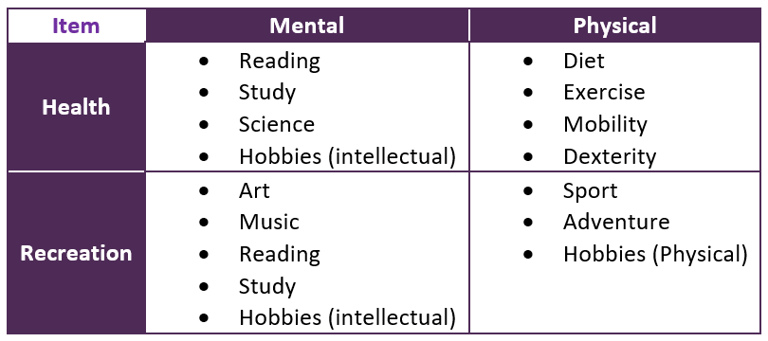
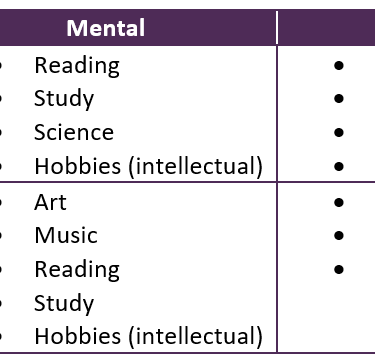
Figure 9 The Health and Recreation Table
A well-rounded approach to health and recreation takes into consideration aspects within each of the four quadrants. The desired approach is for us to be active in each of the four quadrants. For example, a highly physical occupation is balanced by recreation in less physical pursuits and the other way around. Vice, gluttony, greed and sloth diminish our health and recreation. As we age, our health and recreational ability diminish. Illness and or injury reduce our health and ability to undertake recreation. Therefore, we are all advised to take an active approach to taking care of our health and preventing illness. When these do occur; however, we must also manage ourselves as best and as diligently as possible.
The Environment
The environment is everything that makes up our surroundings and affects our ability to live on the earth; the air we breathe, the land and water that covers the earth's surface, the plants and animals, the universe, everything (including us). The environment is ever changing as there are ongoing interactions between plants, animals, soil, water, temperature, light, and other living and non-living things.
Corporate greed, political lust and human overpopulation are the most significant threats to the environment. They tend to work for their own self-interest or needs. They must be countered with equanimity and never-ending diligence to guide human civilization to a point of harmony with the environment. We share the environment with the plants and animals. Without an environment we cannot exist, and they cannot exist. It is the only home we have.
Inequality
Everyone deserves to be equal even though everyone is born different regarding size, shape, colour, sex, ability and so on. In this sense, we are not the same or equal. Philosophically and morally, however, we are equal in our rights for justice, freedom, and opportunity. Unfortunately, this is not always the case in the real world. The status of women in society is an example of physical inequality that is sometimes applied by the male gender. It is discussed below as an example of inequality which is driven by the vice of pride, ignorance, and bullying.
The physical and mental differences between the sexes has survived and flourished over thousands of years. This diversity of ability and aptitude can be a synergy where men and women united can achieve more together than they could individually. Where inequality and subjugation exists, this partnership does not achieve as much as it could.
Inequality can arise because the male is stronger and can impose his will, regardless of rational and fair thinking. This leads to domination and subservience of women, and in some cases, this becomes the accepted social norm. To deny women equal opportunity is to deny society the opportunity to be all it can be.
The path to gender equality lies within ‘The Precepts’ and applying the virtues of diligence and equanimity and accepting that the subjugation of women is a sin of pride, ignorance, and bullying.
There are many other forms of inequality, not just gender, which require our attention. These include race and religious. An analysis of these is not included as gender inequality is sufficient example of the moral lesson.
Sexuality
Sexual orientation has wide variation and for most of us, we are born with a sexual preference that does not change. On occasion however, some individuals find their sexual orientation is at odds with their inward orientation and they may need to make changes to be at peace with who they are. Most sexual orientation is male-female but there also exists preference for the same sex, desires to change sex and individuals born with ambiguous sexuality and still more variations on these.
Biologically, the male-female sexual orientation is the one which most supports the creation of new life. Unfortunately, this mainstream sexual orientation is often labelled ‘normal’ and is sometimes forced on others regardless of their inherited or accepted behavioural traits. Sexual orientation is not morally important. Consideration of ‘The Precepts,’ rules of conduct, personal character and helping others is what is important.
Much of the prejudice that exits between groups of differing sexual orientation is based on a fear of the unknown. Consideration of the moral issues of sexuality requires overcoming of personal fears to have rational thoughts.
Our own sexuality is imbued with such emotion and primal behaviour that we require considerable effort to overcome our bias. Where clear and unbiased thought is brought to bear, sexual orientations can be seen as benign.
Sexual Predation
Sexual predation must be separated from sexual orientation. Sexual predators are an evil entity. They cause extreme harm to others. They exist across all forms of sexual orientation and pose a great threat to all, but particularly those who are physically weaker such as women and children.
Children are open to inappropriate influence at an early age. Sex and sexuality is not a topic for children. Children need to be given the opportunity to develop their own sexuality without influence or prejudice and given the time to mature so they can make informed decisions for themselves.n understanding of the components of happiness is an insight to dealing with unexpected or prolonged unhappiness.
The pursuit of happiness. Some individuals find happiness and maintain that state of mind even after the ravages or tragedies of life contribute to periods of depression. Others must work at being happy or have suffered so much that they need assistance to refocus their perspective. As the pursuit of happiness is aligned with the pursuit of a moral existence, the two are complementary and in some instances the same.
Wisdom is for the wise.
***