PART 7 – REFLECTION
"Ultimately a decision is needed."
Reflection
Self-examination
Self-examination & what is needed to be a better person.
If life’s journey is one of continuous self-improvement, then self-examination never ends. What are our inner thoughts? Do we have an intention to harm? Is there an intention for kind or unkind actions towards others? Is our concern only for self-well-being or attainment of our desires?
Some desires to cause harm and focus on self-interest is normal, but only to a degree. When these intentions are at the exclusion of all others, then we have become an evil persona. For most of us, these are thoughts and emotions that can occur every day and need to be resisted and replaced with positive thoughts and actions. If we, ‘give in’ to such thoughts, we cause harm and in addition suffer remorse and guilt. Our persona slides to the right in the measure of good vs evil.
These are the questions for consideration:
Do you want to be a good person?
Do you want to be a better person?
Do you want to achieve more of the right outcomes and less of the wrong ones?
Do you want to live according to a set of moral standards?
This is your self-examination.
Commitment
For most of us, commitment to a moral set of behavioural standards is a state of mind that already exists within our consciousness. It may not, however, be formally structured in our thoughts. Others must consciously renew their commitment. Commitment to a moral set of behaviour can be internalised in our inner thoughts by applying: ‘The Three Precepts.’ They can be used as a simple and appropriate strategy to analyse our intentions and behaviours. Alternatively, a commitment can be announced publicly, thereby opening us to scrutiny by those around us.
Making a pledge
A formal and public pledge is a means to achieving a personal commitment to an appropriate set of behavioural standards. While this is not necessary, it does provide commitment that forms part of our honour and integrity among those around us. The public nature of such a commitment allows us to draw on the support and expectations of others. Below is an example of a pledge based on the three ‘Precepts’ that can be used to commit to a set of behavioural standards.
hat we do in life, defines us. Mostly, the outcomes of our life are related to the work we do. It provides for us and our families. This includes the most basic levels of work for self-subsistence, unemployment, farmer, business mogul, a President, or the wealthy. The work or actions of our efforts are the vehicle which gives us the means to develop our possessions and the virtues of our character. Alternatively, work and wealth provides opportunity for vice, corruption, and sin. It is also how we assess and measure others.
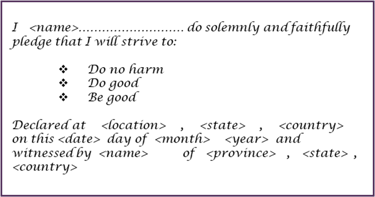
Figure 10 Example Pledge
A decision model
In addition to having intent and commitment to a moral standard of behaviour, improving the quality of moral decision making is important. There is always the potential for the best intentions to go awry and cause more harm than good. Consideration of ‘The First Precept’ often involves consideration of the consequences of our actions and the harm they may cause.
Most of us think in a linear manner. If I do action ‘A’ then outcome ‘B’ will result. Life’s experiences, however, tells us that this is not always the case. There is value therefore in expanding our consideration of alternate outcomes for our actions. By doing this, we can either prepare for these alternate outcomes or put measures in place to try and prevent an unwanted result. For example, I am doing action ‘A’ for outcome ‘B’ however I must plan and consider that action ‘A’ may cause outcome ‘C’ or ‘D’ or ‘E.’
The Decision Helper (DH) is a moral risk analysis tool for improving the outcomes of moral actions and decisions through consideration of unintended consequences. The ‘DH’ comprises three steps. The objective of the first step is to consider two other outcomes from the intended one. These are possibilities where the outcome is different from what is expected. The second step then expands each of the three possible outcomes to consider three possible consequences these outcomes may have. The result is nine possible consequences from three outcomes to be considered. The last step is to review the results and decide whether:
Do not act – the risks are too high
Mitigate – against unintended outcomes and c consequences
Accept the risk of unintended outcomes and continue with the course of action or decision
More detail of the Decision Helper, decision model is provided on the Annex Page.
Absolutes
There are no absolutes. There are no ethics or codes of behaviour that apply to every situation. There is no person with perfect virtue and without vice. There is no person without some goodness who is totally evil. There is no action that does not cause some harm. There are no absolutes, but there are ‘The Three Precepts,’ and they are the guide.
In PART 1 – MORALITY there is a list of ethics. The most basic of these is, ‘Do not kill.’ This is a strict social code that is followed with dire consequences for breaches. Yet in an unjustified attack, a man may raise his hand and take necessary action to defend himself or his family. This right (and need) is widely accepted across society even though it might cross the, ‘Do not kill’ line. Such an action seeks to cause deliberate harm to the attacker. This is a clear example where a balance must be struck between those who act to cause harm and the actions of those who defend against harm and act in accordance with law.
Morality is a balanced judgement of competing considerations. Can an attacking person be subdued without lethal force? If so, then this is the way for self-defence to be applied. If not, then appropriate force must be used. The internal reflection is to ask ourselves; ‘What harm am I causing?’ ‘How can this be prevented?’ ‘Can this harm be minimised?’ ‘Can this harm ever be accepted?’ ‘Is the harm I am causing in context of the good I am doing?’ With the overarching aim of not causing harm, we can answer these questions.
In complex moral situations, an external perspective is more accurate and brings new light to issues. Whenever possible, seek advice and evaluation of proposed actions from valued friends and advisors. For significant events also seek advice and assistance to determine and evaluate all possible outcomes and their possible consequences.
Decision-making.
Human failings need to be overcome and excluded as much as possible from moral decision-making. Some unintended wrong decisions, however, can and will be made, this is unavoidable. In some cases, not making any decision can be worse than making the wrong decision. Do not fear to make mistakes. Be fearful of pride and decision ownership. Do not rationalise against indicators that show a need for change. We cannot find the right path if we do not recognise, we are on the wrong path.
How do we divorce ourselves from our decisions? As soon as a path or decision has been made, look for and identify indicators that you expect to see, that show your decisions are achieving the desired outcomes and intent. Also, identify indicators that you expect to see if the path is the wrong one. Periodically, review and consult external sources for their thoughts. While one or two diverging opinions may not mean much, a cluster of divergent thought needs to be objectively investigated. There is a need to change your direction or revoke decisions that are having the opposite effect to your intended one.
On occasions, we delude ourselves that our decisions are achieving the desired outcomes. This is self-justification and is the practice of making false sense from mistakes and bad decisions. While it keeps our self-esteem in balance, we unknowingly lie to ourselves. (This can be thought of as a psychological blind spot where emotions can trump logic). Be mindful that change is always possible.
Improvement Model
The ‘Morality Model’ and ‘The Relational Model’ provide a simple but clear understanding and perspective of morality. From these models, an approach to achieving a higher level of morality can be undertaken. Some moral issues are simple, others however, have extreme complexity where any or all decisions cause harm or result in wrong outcomes. Dealing with complex issues is always difficult. Whatever model or strategy for improvement is used, the model itself should be simple and easily applied.
Any effort to improve morality needs to be based on increased ethical behaviour, engaging in kind and friendly acts, and embracing virtues and denying vice. This aim is depicted in ‘The Moral Improvement Model,’ below.


Figure 11 The Moral Improvement Model
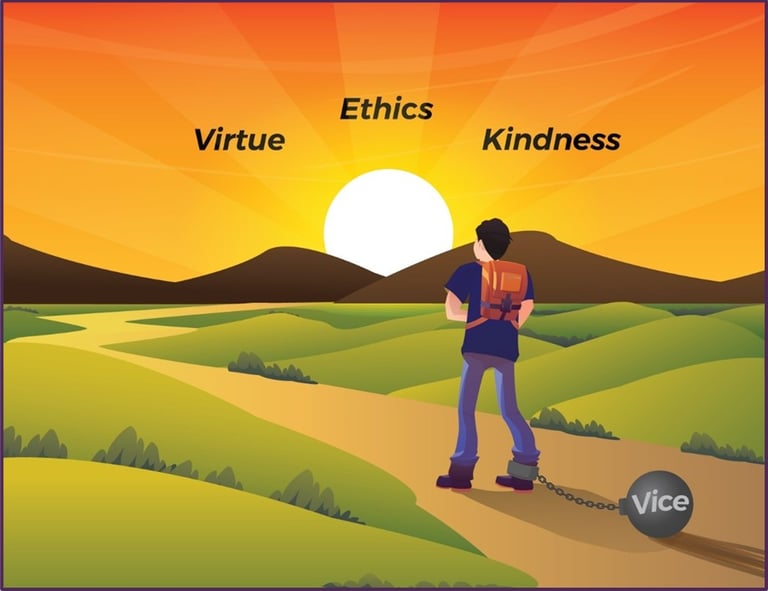
This model is a simple approach that belies the difficulties in discovering the ‘how’ and achieving the motivation to succeed. These challenges however are addressed in the steps to improved moral behaviour.
***