
PART 4 – SELF
"Understanding ourselves is confronting."
Comment - How to be happier?
Who am I?
How you see yourself and how others see you, is not the same. Inwardly, we see all our faults and limitations. Externally, our doubts, our motivations and our thoughts are hidden. That is not to say that either is more accurate, they are simply different. Morality is a significant part of who we are. It leads our actions and accomplishments which are in turn, seen and judged by others.
Finding our place in society is part of growing up and most people start to mature in their early teens. Moral teaching however is mostly learned or established early in life. Parents have a responsibility to teach their children all the aspects of morality and to be examples. Teaching and practicing morality should never stop; however, a focus on early development will mould a developing child with the greatest effect.
Conflict always arise between who you want to be and who you are. This is where our expectations of self, do not meet with reality. Whether growing up or seeking self-improvement, perseverance and determination are needed, as well as some tolerance! Moral achievements provide the greatest rewards of self-esteem and happiness.
Success at work, sport and other worldly pursuits are admirable and to be commended; however, they are unlikely to bring deep and ongoing happiness unless they are pursued in a manner that accords with our conscience and moral code. Most people will never know great success. This, however, does not need to affect happiness or self-esteem where a moral code is followed. Being content with who we are is easy, if our goal is just be a good person.
Self and sexuality particularly come to the fore with the commencement of the teenage years. Most find that their feelings of sexuality conform to those around them. Their path is the easier one. Some will struggle to know, understand or to accept that their sexuality may be different from family or friends. This is the difficult path for which embracing morality and its principles, always assists. It is also the recommended guidance for family and friends supporting those whose sexuality may be different from their own.
In a broader context, opportunity or more importantly, a lack of opportunity, should not be allowed to define who we are. Being taught wrong and being surrounded by vice and corruption can be overcome by embracing and learning morality. It just takes more effort and commitment, but in the longer term it leads to the greatest level of happiness. All the more commendable when moral standing is achieved through adversity.
A moral code leads to a balanced individual capable of weathering life’s stormy seas.
Goals and dreams
The goals that we set ourself and the dreams we harbour are healthy aspects of human nature that push us to achieve what otherwise we may let go. We need to set ourselves realistic and achievable goals that we then take action to achieve. However small or large our goals may seem, they are important. Our goals push us towards our dreams.
We may or may not achieve our goals, but what is important is not to give in, but to continually reassess our situation, have new dreams and give ourselves new goals and direction. There may be sadness after achieving a significant goal as we risk of becoming lost and without cause. The answer is always to have new goals and dreams to pursue. Life is a journey not a destination.
Growing old
We all grow old and die. This is the cycle of life. We do not know when our time will come. It might be years away or just around the corner. For those who are fortunate enough to grow old, they know that their time will come soon. For all of us, regardless of age, the time to set things right is TODAY.
Our perception of life and what is important to us changes as we grow older. As infants, we learn, and we grow. Then, as we mature, we construct our lives with work, family, friends, possessions, and achievements. Later, we begin to feel our mortality and see our place in the world as transient and prepare for our departure. Part of this process is continual reflection of the life we lead and how we judge ourselves. Some will try and make amends for past indiscretion while others will chase lost opportunities.
Embracing a moral code early in life gives greatest satisfaction. This becomes apparent whenever we reflect on our life and our contribution. A moral, modest, and simple life is just as worthy a goal, as those with significant drive, ability and opportunity that seek greatness.
We have essential possessions, however most of what we own is unnecessary and often is just a representation of our perceived success. We often see them as a form of fulfilment. Possessions, however, consume time and resources and the pleasure they bring is mostly limited and usually accompanied by increased responsibility and effort for maintenance. Possessions can own you just as much as you own them. We become their keepers and maintainers. A never-ending craving for possessions can be linked to lust, gluttony, and greed. Family and moral achievement brings far more pleasure and acceptance in our lives. Moderation is always the recommended path.
Happiness
Happiness is the singular greatest pursuit. The intricacies however of what makes a specific individual happy are as diverse as there are people. It is, however, inextricably linked to, and influenced by moral behaviour.
Happiness is difficult to measure, but it can be thought of as having four components:
Fulfilment. Fulfilment is both an emotional and psychological state of mind where one reaches a level of satisfaction with life. The meaning of life is internally reconciled, regardless of belief systems or otherwise and the direction and accomplishment of life meets expectation.
Enjoyment. Enjoyment is also an emotional and psychological state of mind where pleasure and glee are derived from living and engaging in the events and happenings around us.
Resilience. Resilience, with regards to happiness, is our ability to resist both psychologically and physically from being overwhelmed by adversity, misfortune and or evil.
Wellbeing. Wellbeing is our physical and mental health which is core to happiness.
Happiness is a personal and subjective assessment of how one’s emotions are responding to the components of happiness. The emotional response may or may not be balanced or rational; however, it is the sum of the emotional state that dominates the psyche.
Our levels of happiness are never at a steady state, as elements within the components constantly change. Therefore, we experience periods of greater happiness and periods of unhappiness. This is normal. A negative state of mind is unpleasant and inspires us to deal with aspects of life that are the cause of unhappiness.
Unhappiness. Unhappiness is an emotional state where the scarcity or limited achievement of the components of happiness, are such that, the overarching emotional state is negative. Short periods of time in this emotional state are to be expected and are normal. Dealing with tragedy and disappointment is part of life; however, prolonged unhappiness points to misalignment of perspective or poor health. For all tragedy, there is a time for mourning and a time to move on.
Major indicators of unhappiness are suffering, anxiety, lack of satisfaction, being ill at ease and lack of self-esteem. Causes of unhappiness, listed against the most appropriate component of happiness are provided in the table below:

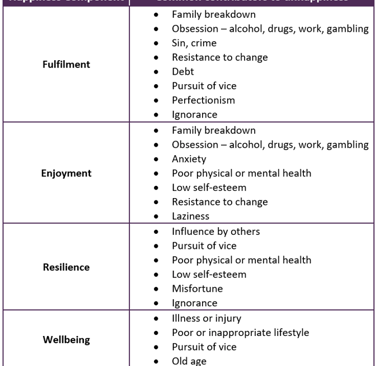
Figure 8 The Happiness Component Table
An understanding of the components of happiness is an insight to dealing with unexpected or prolonged unhappiness.
The pursuit of happiness. Some individuals find happiness and maintain that state of mind even after the ravages or tragedies of life contribute to periods of depression. Others must work at being happy or have suffered so much that they need assistance to refocus their perspective. As the pursuit of happiness is aligned with the pursuit of a moral existence, the two are complementary and in some instances the same.
Happiness is a subjective and subconscious personal assessment that is internalised. Addressing unhappiness is achieved through two distinct processes. The first is alignment of the internalised personal assessment to be happy and content with the status quo. (Be content with what you have and who you are) The second is a conscience review of components of happiness to determine the factors that are lacking and causing unhappiness. The aim being to address these and work to realign the conscience self and make the changes to achieve happiness. (Change what needs to be changed)
Fulfilment. Fulfilment is best understood by defining what makes us satisfied. This is different for everyone. It might be family, work, friends, hobbies, sport, or art. For others, religion and faith plays a significant part. Answering the question of life or what lies beyond death are thoughts that should only be undertaken by those who are already comfortable with their living existence. What is most important is seeking fulfilment from what is achievable. (Do not have unachievable goals!)
If the pursuit of a goal becomes unattainable then acceptance and realignment to new, achievable fulfilment is needed. Denial of vice and actively engaging in virtue aids in fulfilment. Wisdom is needed to overcome ignorance and prejudice (which counter happiness). For most, a moderate approach is the best where extremism, fanaticism and other obsessive behaviours and thoughts are best avoided (including obsessive attitudes to work, wealth, or power).
Enjoyment. Everyone needs to take the time to enjoy life and to reflect on everything around them that is good. This contributor to happiness and is often lacking in those who are unhappy (Not taking the time to smell the roses). Some worry and anxiety is healthy and assists to make good decisions. Obsessive levels of worry and anxiety do not contribute to outcomes and stymie achievement as they create negative thoughts, contribute to low self-esteem, and deny the opportunity for enjoyment.
Resilience. At times you will be surrounded by negative thoughts and tragic news. There will also be times when you are tempted and or offered corruption. Life has its tragedies and failures. Resilience is what gets us through. Strength of character is needed. Believe in what is right and the wisdom of your life’s experience and learning. When weak or waning, seek strength and support from family, friends, and others who you know are strong and are there to support you.
Wellbeing. A healthy body leads to a healthy mind. Take care of yourself and do not ignore issues that need to be addressed by health professionals. Adopt a healthy lifestyle. Do not allow other priorities to dominate. What is the point of fulfilment if you have no health? All the components of happiness need to be addressed and afforded equal priority and importance.
Meditation is a practice used to aid suffering and it also supports fulfilment and happiness. It is prevalent in Eastern culture and has potential to assist with wellbeing. Examine alternate resources and assess their potential to improve your wellbeing.
Extreme failure or sin. An everlasting state of unachieved fulfilment can exist when you fail to meet your own expectations. This can be through indulgence of vice, drugs or committing sin or crime. It might also be an inability to provide for family or failure at business. Failure to make amends and to reconcile (the act or omission) will leave you in perpetual unhappiness. Wisdom, morality, and mental training are the path from perdition. ‘The Precepts’ are the starting point and the direction for self-forgiveness. Repaying a debt to society may also be needed. Reflect on what you can offer life as much as what it can offer you. If unhappiness prevails then you need to seek help and support.
Further reading. Mortality and happiness are strongly linked. Further research and reading is recommended for those looking for greater insight.
***