PART 2 – PERSPECTIVE
"The elements of morality exist in complex interaction."
Morality in perspective
There are many elements to morality, seeking direction or finding a moral compass. Morality is enacted in our lives through:
Intentions
Persona
Character
Actions
Outcomes
Sin
Compass. A compass is a device that provides direction and a point of reference, a moral compass is a guide to for moral thinking and action. The philosophy ‘TODAY’ is a moral compass.
Intentions. Intentions are the purpose or attitude toward the effect of our actions or conduct. Our intentions are the, ‘Why’ behind our actions. Why are we doing this? What outcome are we looking to achieve? To morally understand your intentions, aligned them to ‘The Precepts’.
Persona. Persona is how we are perceived by others and reflects our inner self. Although at times we project a false persona, the true self eventually shows. In consideration of persona and morality, the two projections are good and or evil. Good or evil are descriptions of our moral behaviour along a single sliding scale of intentions.
A good or positive persona is achieved as our intentions focus on not causing harm, helping and support others and the world around us, and improving our virtues and rejecting vice. An evil persona is defined within the same construct but in the negative. The evil persona has intent to cause harm, hinder or hurt others and the environment and to embrace vice and to reject virtue.


Character. Character is the aggregate of features or traits that make us who we are. It is a conglomerate mass of both virtue and vice and the extent to which we apply virtue and deny vice. We are never truly virtuous and without vice. While character is defined in terms of virtue and vice, it is measured by way of our actions and how they are judged. (i.e., good, or bad).
Character is the true balance of who we are, as opposed to persona which is the outwardly perceived aggregate of our vice and virtue by others.
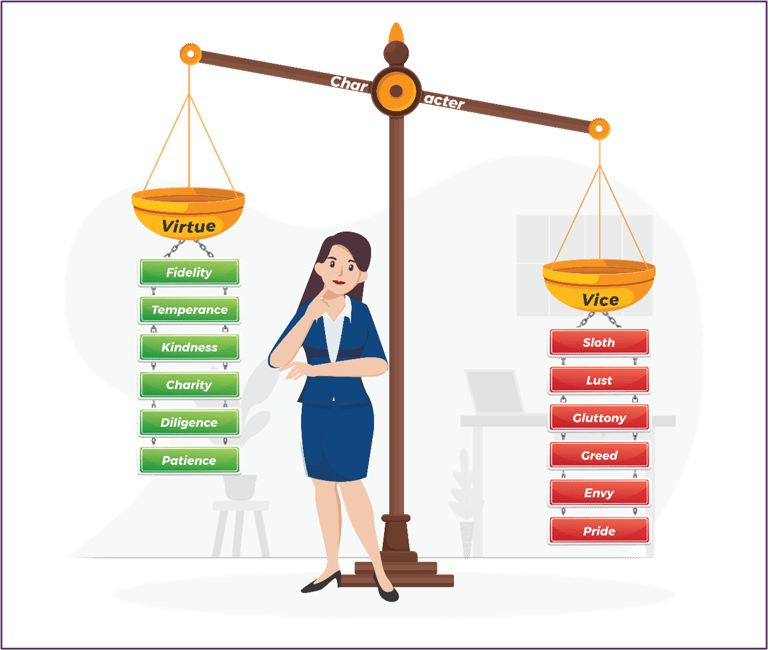
Figure 3 - Persona
Figure 4 - Character
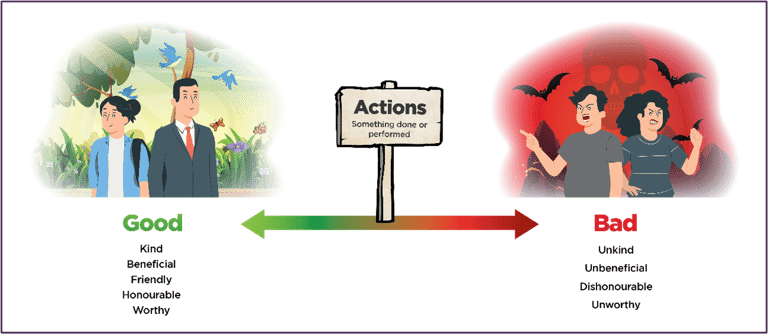
Actions. Morality is applied through action. Our actions are something done, or something performed, either good or bad.
In the same manner that ‘good and evil’ are the same construct in viewing our persona, so too are ‘good and bad’ a single sliding scale of assessing the outcomes of our actions. Good actions are measured in kindness, benefit, friendliness, honor and worth. Bad actions are measured in the exact negative or opposite, i.e., unkindness, un-beneficial, dishonorable, and unworthy. The principal aid to assessment of moral actions is measurement of the outcomes.
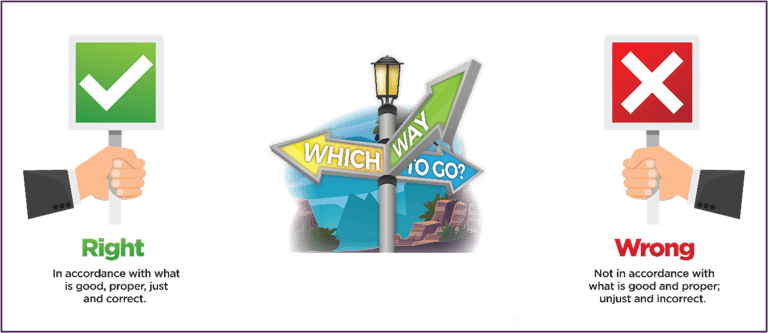
Outcomes. Outcomes are the product, result, or consequence of our actions. The outcomes form the basis for judgement of whether the action was good or bad. These two concepts are again a single construct with two extremes, where ‘wrong’ is defined as the negative or opposite of the ‘right.’ ‘Right’ is in accordance with what is good, proper, or just and correct. ‘Wrong’ is not in accordance with what is good, proper, or unjust and incorrect.
Sin – is:
A violation of moral principles.
Reprehensible actions or behaviour.
Being offense.
Commission of vice.
Sin is applied to a set of moral principles. Where moral principles are broken a sin occurs. It is not applied to transgression of law or other codes of conduct e.g., sport and social clubs, particularly where those codes of conduct are not morally based or are morally irrelevant. These are known as crimes, offenses, or breaches of conduct.
Perdition. Perdition is a living state of ruin based on guilt and remorse occasioned by the pursuit of evil or misfortune that leads to one’s undoing.The Relational Model
The Relational Model
The Relational Model is the relationship between:
Persona,
Character,
Actions and
Outcomes.
It places them into perspective with one another and moral behaviour. Our persona reflects our character which is determined by the actions we perform and the outcomes we produce.
Figure 5 - Actions
Figure 6 - Actions


Figure 7 - Relational Model
***